12 Best Hamstring Stretches & 4 Eccentric Strength Exercises
In this article we will cover the 12 best hamstring stretches in existence.
Toe Touching Hamstring Stretch
Sit and Reach Hamstring Stretch
Door Jamb Contract- Relax Supine Hamstring Stretch for Beginners
Standing Upper Hamstring Stretch
Standing Hamstring Stretch
Seated Hamstring Stretch – Easy Hamstring Stretch for Athletes
Leg Swings- Advanced Hamstring Stretch for Athletes
Contract- Relax Partner Hamstring Stretching
Self Myofascial Release of the Hamstring
Supine Kicks To Stretch The Hamstring
Supine Ankle Rolls To Stretch Tight Hamstrings
Foam Rolling the Lower Hamstring
And 4 Killer Hamstring Eccentric Strengthening Exercises:
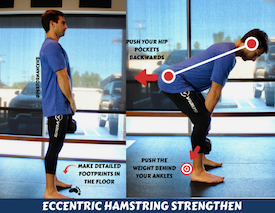
Romanian Deadlift For Eccentric Strength of Upper Hamstring
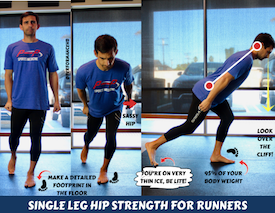
Single Leg Deadlift For Stance Leg Eccentric Hamstring Strengthening
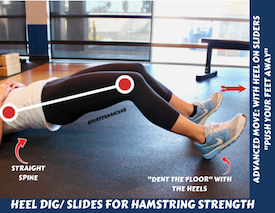
Heel Dig/ Slides For Eccentric Strength of Lower Hamstring
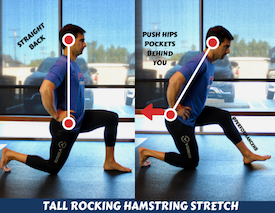
Tall Rocking Exercise For Hamstring Strength
Never Stretch Without Doing This First
STOP!… Do this before you start these stretches!
Get the blood moving. Go for a walk, sit in a chair and get up a few times, or walk some stairs. Do some normal human movement enough to get your heart rate up above resting. It should feel like you’re “getting warm” that’s why they call it a warm up.
It is always a good idea to warm up before you start any hamstring stretches. (Last thing you want is a strain!)
Other options are (but not limited to):
Standing leg curls
Walking lunges
Bridges
High knee walks
Planks
Rolling around on the ground
The hamstring muscle group is located at the back of your thigh and pelvis (at the very bottom) is partly responsible for a well-aligned pelvic position, back health and nerve health.
The hamstring muscles attach from the sit bone (or thigh bone) to the bones below the knee joint. They assist in hip extension and knee bend, which is why they are so important in running gait. Chronic contraction of the hamstrings can dramatically affect pelvic tilts (forward and backwards), creating uncomfortable feeling of tightness in the hamstrings themselves, the low back or groin.
The hamstring muscle group is located at the back of your thigh and pelvis (at the very bottom) is partly responsible for a well-aligned pelvic position, back health and nerve health.
The hamstring muscles attach from the sit bone (or thigh bone) to the bones below the knee joint. They assist in hip extension and knee bend, which is why they are so important in running gait. Chronic contraction of the hamstrings can dramatically affect pelvic tilts (forward and backwards), creating uncomfortable feeling of tightness in the hamstrings themselves, the low back or groin.
The Case For Hamstring Stretching
The question remains… what does hamstring tightness have to do with low back pain?
The roots of the problem is lies within the pelvis region. The following image demonstrates a concept called Lower Cross Syndrome, which shows correlates with low back pain via the “pelvic dial.” When the pelvis has too much forward motion (see the large arrows) this alters the lower back curvatures.
Back pain is common when the lumbar spine is forced to arch too much, as it accommodate to excessive anterior pelvic tilt.
Let’s work on reversing Lower Cross Syndrome, by stretching the hamstrings using a few of the stretches in this article.
EXPECTATIONS WHEN YOU COME SEE US IN COSTA MESA:
MORE THAN 50% IMPROVEMENT WITHIN 4-6 SESSIONS Most Cases
MORE RELIEF WITH LESS RISK We Only Use High Reward/Low Risk Treatments
NO RIDICULOUS LONG-TERM TREATMENT PLANS
MORE ATTENTION WITH A SKILLED GUIDE Even Though our Costa Mesa Chiropractor are Not A "Real Doctor" 🙂
MORE THAN A TYPICAL COSTA MESA CHIROPRACTOR No Bone Cracking Required To Feel Good
NO QUACKERY Dr. Gonzales & Costantino Only Uses Current Evidence-Informed Methods
Hamstrings can become tight for a variety of reasons:
Overuse
Nerve pressure
Too much sitting
Too much running
Lack of hip mobility
Throughout this guide, I’ll show some of the best hamstring stretches in existence. If they don’t work for you then you may need to address your hamstring tightness with a non-stretching correction. Stretching does not fix all hamstring tightness, regardless if it feels good in the moment or not.
In the end of the article, I’ll guide you to another reference that will probably work better if you fall into this category.
What To Expect In This Article
All of the hamstring stretches that you will ever need to know. How to stretch specific areas Pictures + Instructions included Strengthening exercises that actually improve your flexibility What to do if these exercise aren’t working for you
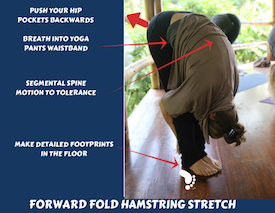
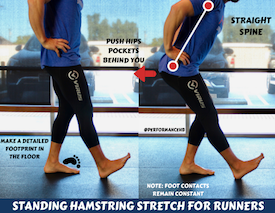
Toe Touching Hamstring Stretch
The most common old-fashioned way to stretch your hamstrings is with a forward fold toe touch. To ensure that you’re releasing long-standing hamstring muscle tension, start the forward bend from the hips. The verbal cue of “pushing your hip pockets backwards seems to work for most beginners.
Since the hamstring starts at the sit bones of the pelvis, “pushing your hips behind you” is all you’ll need to stretch your hamstring in isolation. If you are looking to open up the back as well, simply breath into your yoga pants waistline and segmentally bend from each section of the spine (starting with the lower sections). Keep your feet grounded the entire time.
Don’t bounce in and out of the stretch because it will trigger a protective reflex that will make your hamstring tighten up to protect against the bounce. Hold this forward fold for 30 seconds. It should be comfortable the entire time just like all of the hamstring stretching in this article.
In yoga, they may tell you to “lift your sit bones” to the sky. While this is a great yoga cue, in clinical practice, I’ve found pushing your hips behind your feet works better and is much more protective over other parts of the body. Keeping your feet grounded into the floor should also make you feel more stable, resistant of falling when performing a forward fold.
Sit/ Reach Hamstring Stretch
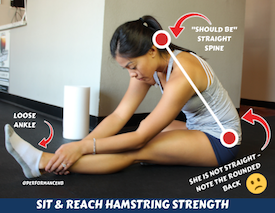
Next up is the sit and reach stretch. An oldie but goodie, the sit and reach hamstring stretch is sadly performed incorrectly often. As previously noted before, your hamstring only travels from the back of the knee to the sit bone. All you really need is a bend of the hip to stretch your tight hamstring. I’ve included some faults in the correlated picture.
How to stretch your hamstrings in the sit and reach stretch:
Sit with only one leg extended (other is bent)
With a “proud chest/ proud posture” lean toward your ankle on the straightened leg
Keep your back flat
Hold the stretch for 30 second, relax for 10 seconds and then repeat.
Door Jamb Stretch
Contract- Relax Supine Hamstring Stretch for Beginners
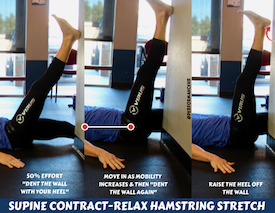
One way to increase hamstring flexibility is using the contract-relax doorway stretch. It is exactly how it sounds, you contract the hamstring and then relax it in a cyclical fashion. Starting on your back is a great way to work towards your goal of touching your toes when standing.
Can everyone touch their toes at the start of a stretching program? No, it takes time. Dancers don’t become flexible overnight and you won’t either. It’s a long-term thing.
Contract-relax stretching for increasing hamstring flexibility has more research than many other types of stretching styles.
Here’s some tips:
When pressing into the wall, attempt to dent the wall with the tip of your heel (30-50% of your full effort)
Contract for 10 seconds
Relax for 5
Slide in closer and do it again
Attempt no more than 5 cycles
Each time you’ll get closer to the wall. This one is amazing for near immediate results.
Standing Upper Hamstring Stretch
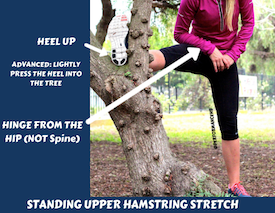
The standing upper hamstring stretch is amazing for runners who start their run in the morning when the ground is wet. Standing hamstring stretching is similar to the seated “sit and reach” stretch in the mechanics.
We can also combine the standing stretch with a contract-relax style that we previously covered.
Finding a tree or park bench place the back of your heel onto the object.
Lean in from the hip socket
Lightly press your heel into the tree or park bench for 5 seconds with about 25% of your full effort and then relax
Move deeper into the hamstring stretch and repeat the contract-relax stretch
Standing Hamstring Stretch
In some situations in life, we can’t get on the ground right? Perhaps, the ground is wet, you’re injured or whatever it may be, standing hamstring stretches are an option.
We covered a few of the standing upper hamstring stretch variation already, but that doesn’t target the lower hamstring. In some people, we need to emphasis the lower hamstring.
Now, we have the standing lower hamstring stretch that I use before nearly every run workout. As with all standing variations, if you have issues with your balance, you may want to perform it next to a wall or chair for assistance.
Press the stance leg foot firmly into the ground for balance
Tap your other “tip of the heel” on to the ground in front of you to a comfortable distance
Press your hip pockets backward, while “bowing to the queen” in front of you
Hold for 30 seconds before changing sides
Remember hamstring stretching and the ability to touch your toes is a process. Only go as far as you can without having pain, strain or extreme effort.
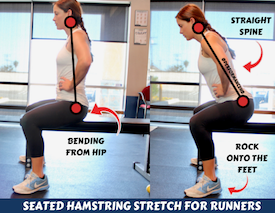
Seated Hamstring Stretch
Easy Hamstring Stretch for Athletes
The seated hamstring stretch, via a hip hinge, is a great beginner stretch for those of you who don’t feel comfortable on your feet because of balance. During this stretch, I like to be comfortably seated with feet as support. Staying tall in the spine, rock your weight into your feet, as if you’re “looking over a cliff to the bottom of a canyon.”
You may feel this more in your upper hamstrings, which is normal, Venture into new ranges, yet keep your entire foot grounded to the floor at all times. Believe it or not, your balance will improve by doing this as well!
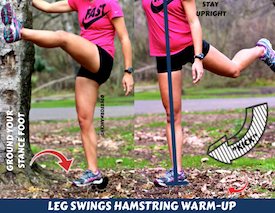
Leg Swings
Advanced Hamstring Stretch for Athletes
If the previous hamstring stretch for athletes isn’t challenging enough, you many want to start each run, bike or swim with some leg swings for your hamstring stretching warm-up. This is one of my favorite to do before a run, because by the end I feel like my hamstrings are nice and warmed up, ready for the long run.
Here’s some steps:
Find a tree, wall or partner
Fully ground the stance leg foot into the floor for balance
As you begin to build amplitude in the leg swing, kick the leafs every time you pass the ground
Brace your belly (like you’re taking a punch) as you change directions
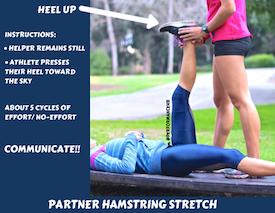
Contract- Relax Stretch
Partner Hamstring Stretching
We previously went over contract-relax stretching for the hamstring on your own, but we can always get more out of the stretch when we have a partner. Use a friend with the same goal of touching their toes or ask your therapist to help. Communication is required when doing this so the person helping out doesn’t harm you.
Lay on your back and have your partner stand over you, cupping your heel in their hand. Remember you’re in control and should be able to tell them when to pause.
Start with the leg slightly bent (like a lazy stretch position)
Your partner should be supporting your leg, not stretching
When you’re ready, “press your heel toward the sky” – your partner is just holding the same starting position while you attempt to straighten your leg
Effort is 10 seconds, relax is 10 seconds, repeat for 5 cycles
As with all of the hamstring flexibility exercises, none of these should create leg pain, numbness or back pain. Consult your doctor before starting a stretching or exercise program.
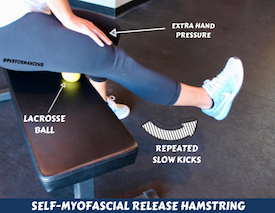
Myofascial Release Of Hamstring
I also use self myofascial release of the hamstrings before my runs. I normally do it before I actually leave the house and drive to my location. I love it!
My hamstrings feel so loose after doing them and the great thing is it only takes a minute or so per leg. Grab a lacrosse ball or baseball and give it a try. Take a look at the picture for more details.
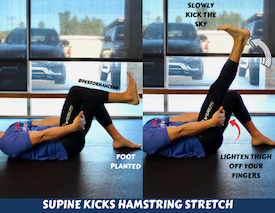
Kicks Stretching The Hamstring
Supine hamstring kicks are great for certain types of hamstring tightness. As mentioned in other sections of this article, your hamstrings could be tight for other reasons. This stretch works well when people are ready for reducing minor neurogenic tightness. If that term doesn’t make sense to you please re-read the “reasons for hamstring tightness” section of this article.
Here are the steps:
Lay on your back with your hands supporting one thigh
With your ankle bent toward your face, slowly knee the leg into a straightened position
Hold for 1 second and then lower
Perform 10 times per side
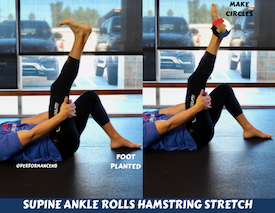
Ankle Stretch Tight Hamstrings
The supine ankle rolls hamstrings stretch is another one that is great for neurogenic hamstring tightness. I have people in my clinic do it only once a day if it works for them because sometimes if you “tickle the dragon” it will wake up and tighten the hamstring again.
Here are the steps:
Lay on your back with your hands supporting one thigh
With your ankle relaxed, straighten your leg
At the top of the motion, perform 10 ankle rolls
Perform 10 times per side
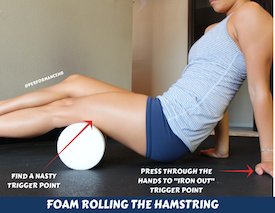
Foam Rolling Lower Hamstring
No matter the type of athlete you are, you’d probably benefit from the use of a foam roller to address those nasty “trigger points/ knots” in your hamstring. A foam roller is a cheap and easy way to decrease local sensitivity after a workout or long day.
Foam rolling the hamstring is best performed after runs and lifts because the pressure will temporarily deaden the stretch response of the hamstring muscle. Performing it before a run will actually make you slower.
Performing foam rolling after workouts, will also assist in your recovery so you can run or lift again sooner, plus feel great doing it!
The steps are simple:
While on the floor, place the foam roller on a trigger point
Use your upper body to modify how much body weight you can tolerate on the area
Spend no more than 1 minute per location
What Causes Tight Hamstrings?
Hamstring tightness can come from many events in life, but if I had to pick the top three reasons they would be:
Sitting too much
Running/ lifting too much
Poor posture in life
I know these all sound very different but like I said, your hamstring could be tight for many different reasons. Just like your car not starting one day, it could be from many reasons. Gas, battery, starter and much more.
When sitting, your hamstrings become tight because they’re in a shortened position too long or because of nerve pressure from the low back (too much arch or round of the spine). Nerve pressure has been documented to increase tone (tightness) of the hamstring muscle. Think sciatica…
While running and lifting, the hamstrings are being actively stiffened because of the workload. Without a good hamstring mobility program, this tightness can become extreme.
Bad posture can lead to hamstring tightness the same way that sitting for a long period can.
Why Stretch Your Hamstrings?
Stretching your hamstring, and then apply workload to the hips, on a consistent basis can yield massive improvements in your health.
Here’s just a few improvement you may expect to see:
Better posture
Less back and nerve pain
Reduction of recurrent hamstring strains
Less pain with motion that matter (walking, standing up from a chair, sex, travel)
Eccentric Hamstring Strengthening Exercises
Eccentric exercise is the key to retaining the flexibility you gained after a hamstring stretching session. Without adding resistance to the hamstrings on a consistent basis, do not expect your hamstring to stay loose for long.
The reason I created this article was to educate the public that hamstring stretching is great, but useless when not coupled with strength training. This combination approach is why contract-relax stretching works so well.
Use the following exercises to keep your hamstring flexibility.
Eccentric Strength of Upper Hamstring
Romanian Deadlift
High eccentric hamstring strength has been linked to having less hamstring strains. Less hamstring strains lead to less hamstring tightness. Eccentric strength is being strong as the hamstring elongates, decreasing possibility of hamstring tears. This carries over to running.
Throughout running gait, the hamstrings encounter these eccentric loads often and can become strained if they haven’t previously been exposed to forces of that type. Using controlled motion in a gym setting is the safest way to expose the hamstrings to high risk eccentric loading.
The romanian deadlift is a great option for beginning to develop eccentric hamstring strength.
Here are some tips:
Ground the feet
Slowly push the weight behind your ankles
Change weights and challenge your range
Reps will range from the 5s to 10s, anything more is too light of a weight
With any hamstring strengthening exercises, you should never feel back pain, extreme stretching or discomfort in the hips. Contact a doctor if you do.
Single Leg Deadlift For Stance Leg Eccentric Hamstring Strengthening
Once we have mastered two legged hinges, such in in the Romanian Deadlift, we can move to single foot variations. I do this with no weight, or less weight, than two foot deadlifts. If you perform this the correct way, you should feel your stance leg glute muscles start to work.
Here are the steps:
Ground the stance foot
Look over a cliff
Have 95% of your weight into the front foot
Get sassy in the hip
Turn your belt buck into your stance leg pocket
Hold the position until your glute is tired
Performing glute strengthening exercises, especially in single leg motions, OFFLOADS the hamstring, which makes it become overworked less often. We are teaching the body to share the workload produced with human movements like sitting, walking, lifting and running. This leads to less spikes in hamstring eccentric loading during movements like running, which lead to repeated hamstring strains and tightness.
Eccentric Strength of Lower Hamstring
Heel Dig/ Slides
Heel digs are a great way to strengthen the hamstrings is a safe way. It’s the starting exercise I give many injured runners. Isometric, non-motion contractions/ holds, assist in allowing the hamstring to remodel its proteins so we can “lock in” the nice, loose feeling we have after doing hamstring stretches.
An advancement of this exercise is to use furniture sliders to “push the heels” and elongate the knee, yielding another eccentric hamstring strengthening exercise. Training eccentrically will decrease potential hamstring strains.
Here are the steps:
Lay on your back
Bend the knees and bridge your hips up
Hold the position and try to dent the floor with your heels
Tall Rocking Exercise
For Hamstring Strength
Tall rocking hamstring stretches are great and they combine eccentric strength-hinging/ control with a nice stretch. Take a look at the image and give it a try. Think of it like a kneeling version of the Romanian Deadlift.
What If None Of These Hamstring Stretches Or Exercises Worked?
It is possible and common that these don’t stick… why do you think there are so many tight hamstrings out there?!
There’s a missing part that is often not too hard to find, but just like having a dead car, there are a few very simples additions that could solve your issues (gas, key, & put it in park).
SHOW NOTES Tight hamstrings are a chronic issue for many runners and lifters. What creates the sensation of a "tight hamstring" when you can actually touch your toes? Are the hamstrings really tight or do they just feel tight? Did you have a "pop" occur in the hamstring region? Did it bruise? Does your back hurt? In this podcast, I asked my serial co-host (Dr. Cody Dimak DC) to have a discussion about all of the common questions/ considerations patients may have when they're experiencing symptom
Are you constantly battling 'tight' hamstrings, no matter how much you stretch? You might be missing the real culprit! In this episode, we dive deep into the common misconception of hamstring tightness and reveal how Lower Cross Syndrome, characterized by weak glutes and core muscles, can create the illusion of tight hamstrings. Discover why your body is compensating and learn practical, effective exercises to activate your glutes, strengthen your core, and finally address the root cause of your
After 7 months of failed treatment, a marathon runner's chronic hip flexor pain improved 90% in 3 days. The exam, plan, and rehab behind the turnaround.
A 4-week video rehabilitation plan for single-sided heel pain — built specifically for runners and long-distance hikers, not a generic plantar fasciitis routine.